



India’s push towards electric mobility is beginning to reshape the country’s manufacturing workforce at a fundamental level.
As policymakers and businesses intensify efforts to reduce fuel dependence and accelerate EV adoption, automotive factories are confronting a parallel challenge: preparing workers for an entirely different production environment.
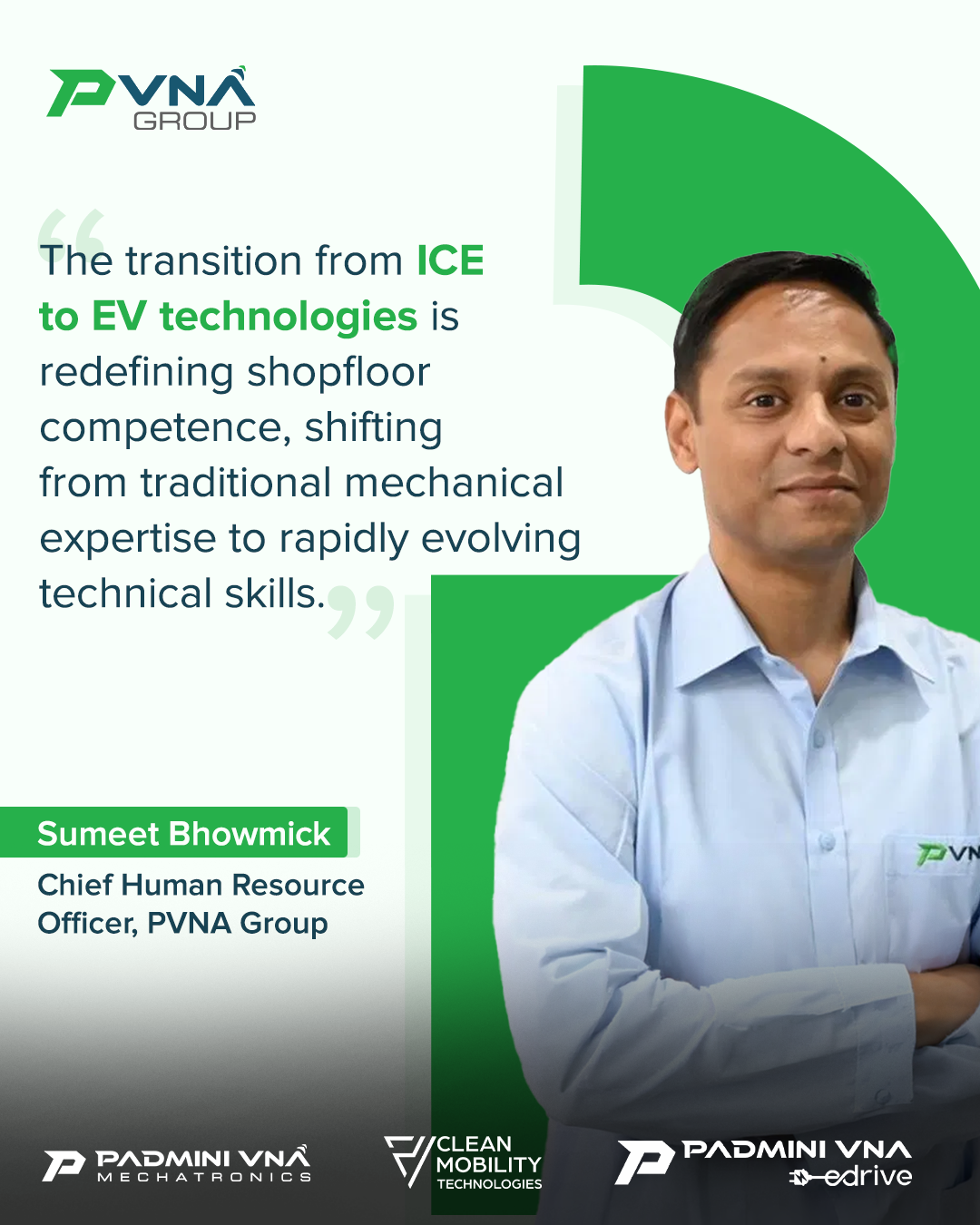
According to Sumeet Bhowmick, Chief Human Resource Officer at PVNA Group, the transition from internal combustion engine manufacturing to electric vehicle production is changing not only technical requirements on the shopfloor, but also the operating culture inside factories.
“The transition from ICE to EV technologies is redefining shopfloor competence, shifting from traditional mechanical expertise to rapidly evolving technical skills,” Bhowmick told People Matters.
He said EV manufacturing environments now require continuous learning because technical knowledge becomes outdated far more quickly than in conventional automotive assembly.
Traditional factory skills are no longer enough
The shift towards EV production is forcing manufacturers to rethink the skills historically associated with automotive assembly work.
For decades, mechanical precision and process familiarity formed the backbone of shopfloor operations in component manufacturing. EV production, however, increasingly demands competence in electronics, software-enabled systems and data-driven manufacturing environments.
Bhowmick said the challenge is particularly visible among experienced factory operators transitioning from conventional automotive systems.
“Electronics fundamentals: understanding circuit behaviour, voltage tolerances, EMI, and insulation resistance, represent a genuine challenge for operators who have spent careers in a mechanical paradigm,” he said.
“These are not skills you can develop through a weekend workshop.”
According to Bhowmick, EV production also requires workers to operate within digitally integrated manufacturing systems where data interpretation and real-time monitoring are becoming routine operational expectations.
www.peoplematters.in/article/sustainability-and-esg/as-india-battles-fuel-pressures-ev-factories-face-a-growing-skills-gap-49766


